The Age of Faith
We are exiting the age of reason and reentering the age of faith.
In 1651, in the aftermath of a century of religious war, Thomas Hobbes set out to end the age of faith. Leviathan would swap the quarrelsome authority of priests and prophets for a single secular sovereign. It did this by recasting the human being as a piece of machinery. Man became matter in motion. The commonwealth became an artificial man, and sovereignty its artificial soul. Hobbes stands at the dawn of the disenchanted West, the world we have inhabited for roughly two and a half centuries.
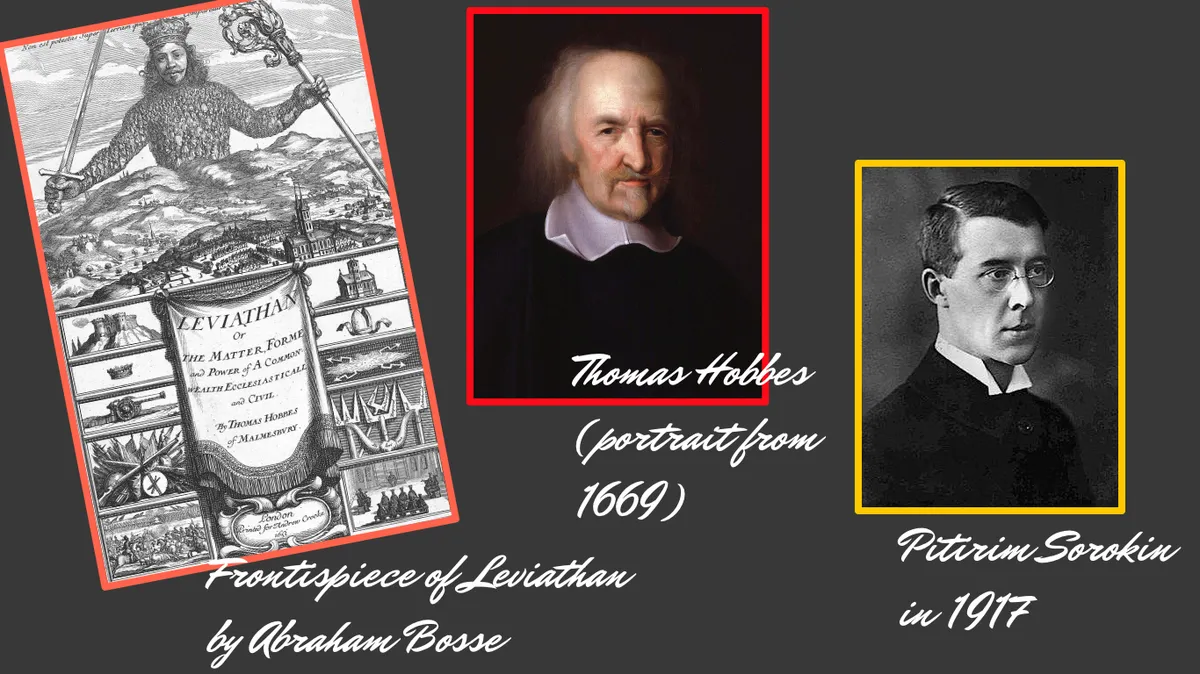
The wheel he set turning has nearly closed its arc. Some call it the Age of Reason, and some call it the industrial age. Sociologist Pitirim Sorokin named it the Sensate age. By any title, it is exhausting itself, and on every front at once. The clearest signature of that exhaustion is the return of faith. By faith I mean something broad, as in the return of the transcendent. Like a search for meaning that runs straight past material progress. And the slow re-enchantment of a world that three centuries of science and commerce had so carefully drained of it.
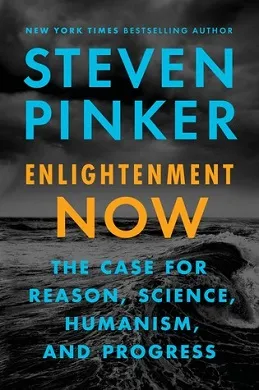
The dominant story of the modern West runs in a straight line. Auguste Comte gave that line its cleanest form in his law of three stages: humanity hauls itself up out of the theological, works through the metaphysical, and lands in the positive or scientific stage, where Comte expects it to remain for good. Steven Pinker's Enlightenment Now is the same line again, only redrawn with the data of our own moment.
Against it stands an older and stranger tradition that sees history as a tide. Giambattista Vico described a corso e ricorso, a recurrence through the ages of gods, heroes, and men that ends in collapse and a return to the divine. Oswald Spengler gave the pattern its seasons and gave us the term for our moment: the Second Religiousness, the resurgence of faith in the winter of a civilization, after its money-driven megalopolis has burned through its vitality.
Sorokin made the cleanest case of all. Cultures, he argued, swing between the Ideational, which draws its truth from revelation, and the Sensate, which draws its truth from the senses; and the late Sensate phase decays into materialism and sensation-seeking before the pendulum swings home. We are, on his reckoning, very late in a Sensate age, and the evidence is now visible in the very places the modern world was proudest of.
Economy
The industrial revolution had its heroic builders, men like Ford, who put a nation on wheels, and Rockefeller, who consolidated an industry and then turned to founding institutions; whatever else one says of them, they made things. The energy of that age has since thickened into something more extractive, a genius for capturing rent in place of a genius for making the new. Joseph Schumpeter named the mechanism in 1942, predicting that capitalism would be undone by its own success as the entrepreneurial spark routinized into bureaucracy and the cold, calculating spirit of the system dissolved the loyalties of faith, family, and nation that had once sustained it. Max Weber had already supplied the governing image. The Protestant faith built capitalism; capitalism then outlived its faith and hardened into what he called the iron cage, a machine that runs without belief and offers none.
The same shape shows in our technology, though we are trained to see only acceleration. Robert Gordon's history is more sobering than the marketing. The century from 1870 to 1970 was a special century, he argues, the age of electricity and the internal combustion engine, of running water and sanitation, the telephone and antibiotics, a transformation in the texture of daily life that is unlikely ever to repeat. What has come since clusters in the narrow channel of information and entertainment, and Gordon's provocation, hard to unthink once stated, is that indoor plumbing changed human life more than the smartphone.
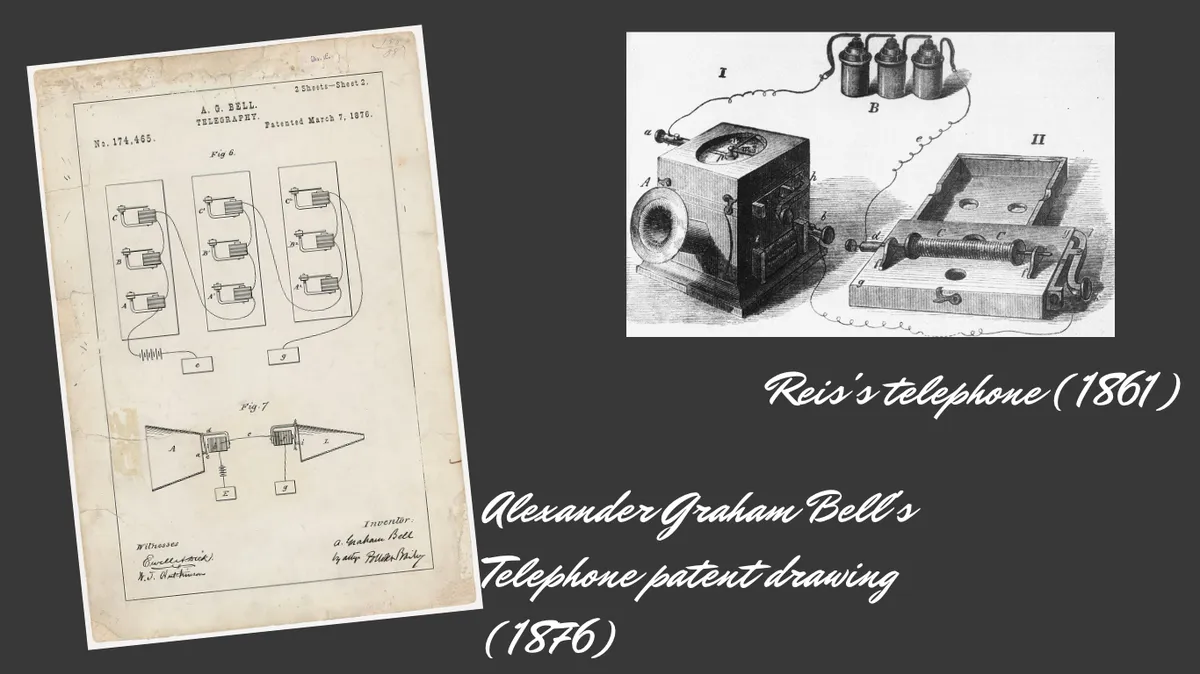
We went from silence to telephony, and then from Netflix to TikTok; the marvels keep arriving and keep mattering less. The culture that consumes them shows the classic late-Sensate symptom, a falling return on stimulation, more screens and images and sensation answered by a population that reports itself more exhausted and less nourished than before.
Science
The most telling exhaustion is in science itself, which was the cathedral the modern world raised in place of the old one. The cathedral is cracking at the frontier. Pharmaceutical research labors under its own grim law, sometimes called Eroom's Law, Moore's Law spelled backward, by which the number of new drugs per dollar of research fell by half roughly every nine years for decades, so that we must run ever harder simply to stand still. (In honesty, mRNA vaccines, the GLP-1 drugs, and AlphaFold suggest that law may now be bending the other way, and an essay worth reading should say so.)
Fundamental physics tells a stranger story. Its grandest theory, string theory, has held the field for two generations while producing not a single prediction that anyone can test, and critics from inside the discipline, Sabine Hossenfelder among them, describe a physics that has begun to prize mathematical beauty above the discipline of evidence. Here is the irony that gives this essay its title. When physics cannot test its highest theories, some of its theorists have proposed loosening the requirement of testability itself, Karl Popper's falsifiability, the very rule meant to divide science from faith. At its furthest edge, science drifts back toward the thing it was built to replace.
Two of the modern world's sharpest minds foresaw this. Kant, marking the boundary of what reason could ever accomplish, wrote that he had found it necessary to deny knowledge in order to make room for faith. And Nietzsche, usually misremembered as faith's executioner, understood that the executioner was himself a believer. The will to truth that drives the scientist, he argued, is the last and most refined form of the ascetic ideal: it is still a metaphysical faith, he wrote, upon which our faith in science rests. Even the godless anti-metaphysicians take their fire from a flame lit thousands of years ago by the conviction that truth is divine. Science was always a faith. Only now, as its frontier runs short of testable ground, is the faith becoming visible again.
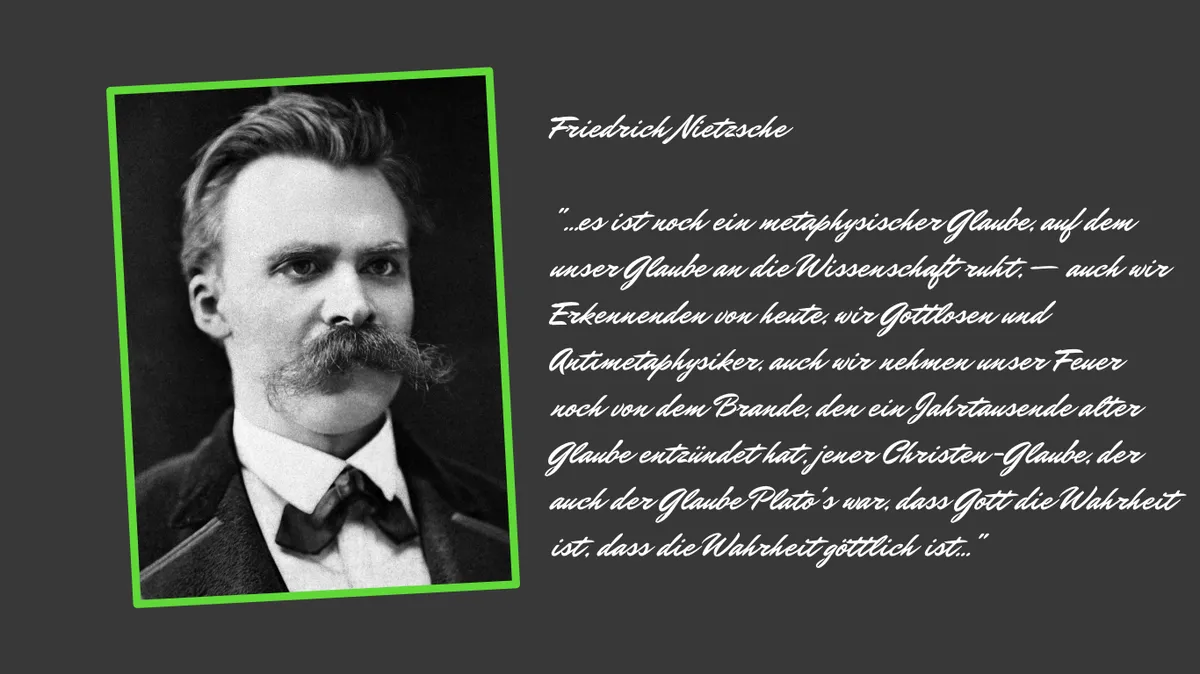
When a civilization's central faith fails, the space it held does not stay empty. Nietzsche understood this as well; his madman runs into the marketplace crying that God is dead and that we are his murderers, and the announcement lands as a wound whose consequences are still in the post. The twentieth century spent that inheritance, and what returns now, in the aftermath of the spending, is the old hunger in new dress. Charles Taylor described our secular age as a condition in which belief has become one option among many, where the closed and disenchanted frame keeps generating its own counter-pressures and a nova of new spiritual options blooms in the vacuum. There are early signs of such a turn among the young, a sense across the culture that the long tide of unbelief has reached its high-water mark. The strangest of the new options grows from the very technology that was supposed to have buried God: the dream of artificial general intelligence has taken on the shape of an eschatology, with its coming superhuman power, its day of judgment, its hope of salvation and its answering dread. The movements gathered around existential risk and the far future speak, when you listen closely, a theological grammar of sin and salvation, prophecy and election.
The honest objection to all of this is severe, and it is better to raise it oneself. Karl Popper, whose falsifiability the physicists would now abandon, spent a whole book, The Poverty of Historicism, arguing that precisely these grand cyclical schemes, the Spenglers and Toynbees and Sorokins, amount to unfalsifiable narrative: patterns the mind presses onto the past and then mistakes for law. He was largely right. And here the argument folds back on itself in a way at once uncomfortable and clarifying. The forecast of a coming age of faith is about as testable as the forecast of a multiverse, and the tide-theory of history shares string theory's vice. To predict the return of the sacred is itself an act close to faith.
Set the machinery of cycles aside, and a more modest claim survives that needs no philosophy of history to stand: the progress narrative, the story that material and scientific advance is the engine of human meaning, is loosening its grip after two and a half centuries. Denied transcendence through progress, people look for it elsewhere, and they are looking now. Whether the right name for what they find is faith, or re-enchantment, or simply the return of the sacred, the long arrow of the modern age is bending back into a circle. Lecturing in 1917 on science as a vocation, Weber would not say what lay on the far side of disenchantment; he would only wonder whether new prophets awaited us, or some great rebirth of old ideas.
A century on, his question is still open, and it has stopped sounding rhetorical. Somewhere within it, Hobbes's great machine, the artificial man with its artificial soul, is finally and audibly running down.