How do mathematicians reach consensus?
My bubble and I have been reading Tanya Klowden and Terry Tao's new state-of-the-union style philosophy paper on AI, Mathematical methods and human thought in the age of AI. I should probably write a post about it sometime.
In that paper, Tanya and Terry mention this other paper, Roy Wagner's "Mathematical consensus: a research program". I looked it up. It is open access on Springer. I was a bit surprised to have missed this paper, it seems very much my alley.
I read the paper today, and boy was it fun.
One of the distinguishing features of mathematics is the exceptional level of consensus among mathematicians.
That's the first line of the abstract. Which we all internally just know perhaps. But when said like that, it gave me goosebumps. What does this mean philosophically? About the human condition etc. Anyway, if you're into math, you might immediately say, "Formalisation techniques ofc!".
Since a sharp rise in consensus occurs around the turn of the 20th century, it makes sense to explain this consensus by the concurrent formalization of mathematics.
So you'd be right, and it's interesting that formalization has become such a main thing only recently.
There is obviously a lot of history here.
... in earlier European mathematics and other mathematical cultures, consensus about the validity of arguments was substantially weaker or conceived differently than it is today. This means that contemporary consensus about the validity of mathematical proofs should be explained by historical changes in mathematical practice.
He ends the abstract by saying he will explore what actually brought about the contemporary form of mathematical consensus. Nice.
He begins the introduction section with his definition of mathematics, which I find quite beautiful.
It is commonplace to observe that mathematics is the realm of knowledge distinguished by a clear agreement on right and wrong answers.
But then he immediately corrects into the obvious nuance. Mathematicians don't actually agree on truth. They disagree about the axiom of choice and about whether asking if an axiom is "true" even makes sense. What they do agree on is whether a given proof is valid. That's the consensus we are interested in, and it's a much more specific and interesting claim than "math people agree on stuff".
So how do mathematicians reach their consensus? He articulates a dance.
Mathematician P (prover) suggests a proof. Mathematician C (critic) challenges it. The challenge is of the form “I don’t quite see how you justify this statement in the proof”. The answer may draw on a large variety of tools: known theorems, analogies to known similar cases, explication of implicit steps, reference to a diagram, etc. After a while, C may be persuaded that the proof is valid, P may be convinced that it is not, or C will require a re-write of some aspects of the proof. Several iterations may follow, at the end of which, usually (but not always), the prover and critic will reach an agreement concerning the validity of the proof.
There's a twist though.
P: my proof is valid
C: no what about X?
P: see X is actually A, B, C
C: yeah the old proof isn't valid, the new one is a new proof
That's the simple dance. There are ofc more complex dances. The story of the abc conjecture is one such. That thing is still unresolved.
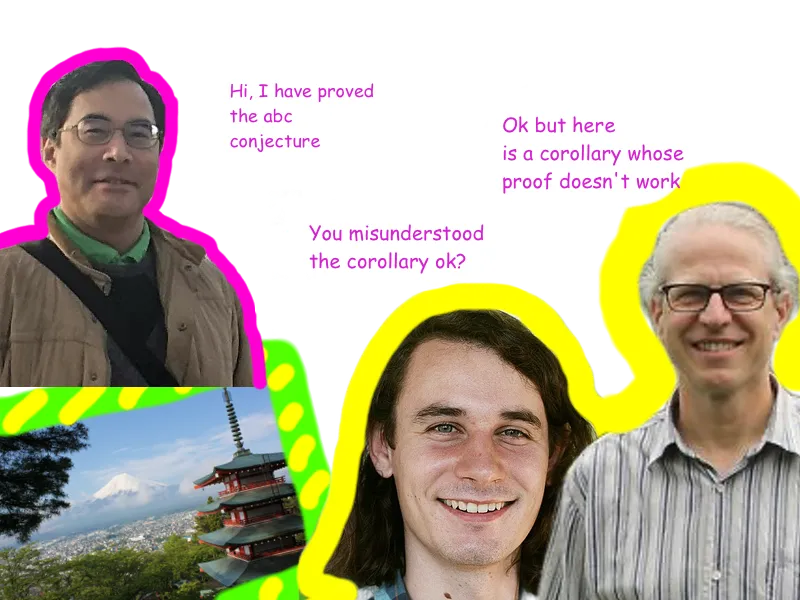
Perhaps the most famous contemporary disagreement about the validity of a proof (again, not entangled with the problem of individuation), is Shinichi Mochizuki’s purported proof from 2012 of the abc conjecture. The majority of the mathematical community finds the proof impenetrable or outright invalid, but a circle of supporters is still convinced. In 2018, the efforts of two critics, Peter Scholze and Jakob Stix, culminated in pointing out a corollary whose proof doesn’t work. Mochizuki, however, claims that they simply misunderstand the corollary (Klarreich 2018). As one commentator put it, Scholze and Stix “appeal to ‘certain radical simplifications’ that seem to get the heart of the matter, but they are also aware that ‘such simplifications [might] strip away all the interesting mathematics that forms the core of Mochizuki’s proof’. … It is this that Mochizuki condemns as illicit, and in his own support, he offers a number of examples that, he claims, lead to incorrect results if so treated. But Mochizuki, in defending himself, again uses some idiosyncratic definitions for common constructions in category theory, while still using standard terminology.”
The paper goes on. The quick paper preview blog post ends here, but I highly recommend giving the paper a read, it is a fun one.